Contents
- 1 Understanding Prime Rib Cooking Basics
- 2 How to Choose the Right Prime Rib Roast
- 3 Essential Equipment for Accurate Prime Rib Cooking Times
- 4 How to Prepare Prime Rib for Correct Cooking Times
- 5 Prime Rib Cooking Times by Temperature (The Ultimate Chart)
- 6 Internal Temperature Guide for Perfect Doneness
- 7 Step-by-Step Instructions Using Time and Temperature Charts
- 8 Special Notes for Boneless Prime Rib Cooking Times
- 9 Cooking Time Examples
- 10 Resting Times Based on Roast Size
- 11 Carving Tips for a Perfect Presentation
- 12 Frequently Asked Questions
Prime rib is one of the most impressive and luxurious roasts you can serve during the holidays, special occasions, or Sunday family dinners. Its incredible tenderness, beautiful marbling, and rich beef flavor make it a showstopping centerpiece—but the one thing that often intimidates home cooks is time. How long do you cook a prime rib roast? At what temperature? How do you adjust for bone-in versus boneless? And how can you get your desired level of doneness exactly right?
This long-form guide compiles the ultimate prime rib roast cooking time chart, giving you complete clarity on oven temperatures, minutes-per-pound methods, doneness stages, and everything you need to achieve a perfect roast every single time. Designed to answer common searches like prime rib cook time, how long to cook prime rib, prime rib oven guide, and holiday beef roasting chart, this is your all-in-one reference for roasting with confidence.
Whether you’re preparing a rare, rosy center or a medium roast for a crowd, this detailed breakdown removes the guesswork. You’ll get not only a robust temperature chart but also preparation tips, resting guidelines, carving techniques, and troubleshooting solutions that keep your prime rib tender, juicy, and full of flavor.
This resource is structured to be both beginner-friendly and highly thorough, combining cooking science with practical kitchen wisdom. Consider this your personal prime rib roadmap, updated for modern ovens and holiday cooking needs.
Understanding Prime Rib Cooking Basics
What Prime Rib Really Is
Prime rib, also called standing rib roast, comes from the primal rib section of the cow. It includes some of the most tender and flavorful cuts, thanks to ample marbling and soft connective tissue. You’ll find two main versions:
-
Bone-in prime rib, which has ribs attached and often cooks more slowly and evenly
-
Boneless prime rib, which cooks slightly faster but is easier to carve
Both versions follow the same temperature guidelines, but cooking times vary slightly.
Why Cooking Times Matter
Prime rib’s fat marbling melts slowly, basting the meat from within. Overcook it, and you lose that luxurious texture. Undercook it, and the center may be too rare for some guests. A precise time and temperature plan ensures:
-
Even cooking
-
Optimal tenderness
-
Consistent doneness
-
A predictable serving window for holiday meals
The Role of Oven Temperature
Different oven temperatures produce different textures:
-
High heat creates a crisp crust
-
Low heat creates even doneness
-
Combination methods create the best of both worlds
This guide covers multiple methods, so you can choose what suits your schedule and preferred results.
How to Choose the Right Prime Rib Roast
Bone-In vs. Boneless
Bone-In Benefits:
-
Natural roasting rack
-
Juicier results
-
More flavorful
Boneless Benefits:
-
Easy slicing
-
Cooks slightly faster
-
Ideal for smaller ovens
How Big of a Roast Do You Need?
-
Bone-in: 1 pound per person
-
Boneless: ¾ pound per person
-
For generous portions or heavy eaters, increase by ½ pound per person
Quality and Marbling
Look for:
-
Even marbling
-
Bright red color
-
Firm fat cap
Essential Equipment for Accurate Prime Rib Cooking Times
Oven Thermometer
Ensures your oven temperature is accurate (many ovens run 10–40 degrees off).
Meat Thermometer
The key to hitting the exact doneness level. A digital probe thermometer is ideal.
Roasting Pan
Shallow sides allow heat to circulate for even cooking.
Cutting Board and Carving Knife
A long slicing knife makes tidy slices and prevents tearing the meat.
How to Prepare Prime Rib for Correct Cooking Times
Let the Roast Warm Up
Let it sit at room temperature for 1½ to 2 hours before roasting. A cold roast cooks unevenly and takes longer.
Pat the Roast Dry
A dry surface promotes browning.
Season Generously
Salt, pepper, garlic powder, onion powder, and optional herbs help build a crust.
Set Up Your Roasting Pan
Bone-in roasts naturally sit on their ribs. For boneless, use a rack.
Prime Rib Cooking Times by Temperature (The Ultimate Chart)
Below is the comprehensive guide to prime rib roasting times using common oven temperatures. Cooking times are approximate, so always rely on a meat thermometer to finish accurately.
Oven at 250°F (Low and Slow Method)
Produces extremely even, juicy meat.
Bone-In Roast:
-
Rare: 20–25 minutes per pound
-
Medium-rare: 25–30 minutes per pound
-
Medium: 30–35 minutes per pound
Boneless Roast:
-
Rare: 18–22 minutes per pound
-
Medium-rare: 22–26 minutes per pound
-
Medium: 26–30 minutes per pound
Oven at 325°F (Classic Method)
A balance between crust and interior tenderness.
Bone-In Roast:
-
Rare: 15–17 minutes per pound
-
Medium-rare: 17–20 minutes per pound
-
Medium: 20–22 minutes per pound
Boneless Roast:
-
Rare: 13–15 minutes per pound
-
Medium-rare: 15–17 minutes per pound
-
Medium: 17–19 minutes per pound
Oven at 350°F (Faster Roast with Good Browning)
More browning, slightly more variance in doneness across the roast.
Bone-In Roast:
-
Rare: 13–15 minutes per pound
-
Medium-rare: 15–17 minutes per pound
-
Medium: 17–20 minutes per pound
Boneless Roast:
-
Rare: 12–14 minutes per pound
-
Medium-rare: 14–16 minutes per pound
-
Medium: 16–18 minutes per pound
High-Heat Method (450°F Start + 325°F Finish)
Great for crisp crust formation.
-
Roast at 450°F for 15 minutes
-
Reduce to 325°F and cook until done
At 325°F Stage:
-
Bone-In: 11–13 minutes per pound
-
Boneless: 10–12 minutes per pound
Reverse Sear Method
Slow roast at 250°F until 10°F below target temperature, rest, then blast at 500°F for 5–10 minutes.
Cook time follows the 250°F chart, then add the final sear.
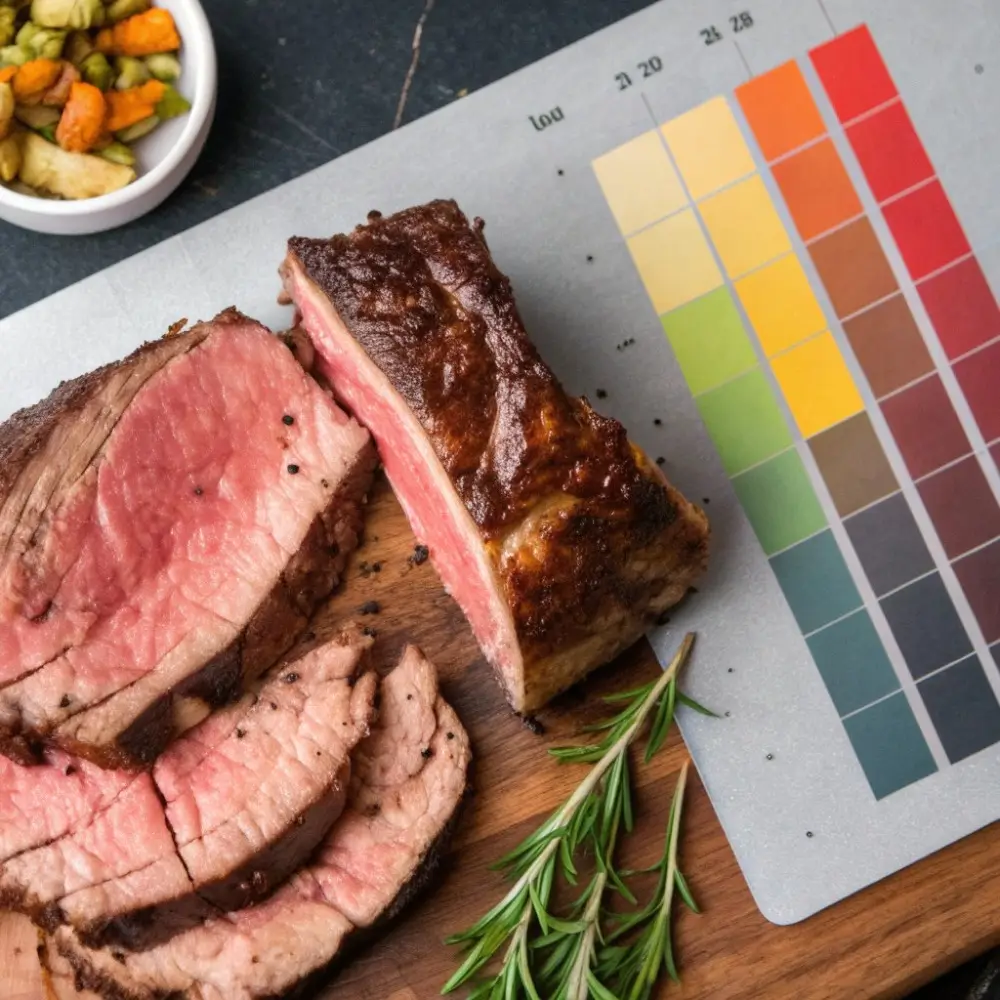
Internal Temperature Guide for Perfect Doneness
-
Rare: Pull at 115–120°F → Final temp 125°F
-
Medium-Rare: Pull at 120–125°F → Final temp 130–135°F
-
Medium: Pull at 130°F → Final temp 140°F
-
Medium-Well: Pull at 140°F → Final temp 150°F
(Prime rib is typically not recommended well-done due to dryness.)
Carryover Cooking
A prime rib rises 5–10 degrees while resting. This is why removing the roast slightly early is essential.
Step-by-Step Instructions Using Time and Temperature Charts
Step 1: Preheat Oven
Choose your method: low/slow, classic, or high-heat start.
Step 2: Prepare Roast
Dry, season, and place on rack.
Step 3: Insert Thermometer
Insert into thickest part without touching fat pockets or bone.
Step 4: Roast According to Chart
Use the time chart as a guideline. Check temperature 30 minutes before expected finish.
Step 5: Rest for 25–45 Minutes
Do not skip this step—resting allows the juices to redistribute.
Step 6: Carve
Slice against the grain for maximum tenderness.
Special Notes for Boneless Prime Rib Cooking Times
Boneless roasts cook 10–15% faster because there’s no bone insulation.
Adjust by:
-
Reducing total time
-
Checking temperature earlier
-
Using a thermometer as your final decision-maker
Cooking Time Examples
Example 1: 6-Pound Bone-In Prime Rib (Medium-Rare)
Using 325°F classic method:
6 pounds x 17–20 minutes per pound = 102–120 minutes
Expect around 1 hour 45 minutes.
Example 2: 4-Pound Boneless Prime Rib (Rare, Low and Slow)
4 pounds x 18–22 minutes = 72–88 minutes
Around 1 hour 15 minutes.
Example 3: 8-Pound Bone-In Prime Rib (High-Heat Start Method)
450°F for 15 minutes
Then 325°F for 8 pounds x 11–13 minutes = 88–104 minutes
Total cook time: about 1 hour 45 minutes to 2 hours.
Resting Times Based on Roast Size
-
Small roasts (3–4 lbs): 20–25 minutes
-
Medium roasts (5–7 lbs): 25–35 minutes
-
Large roasts (8–10 lbs): 35–45 minutes
Don’t tent tightly—loose foil only.
Carving Tips for a Perfect Presentation
For Bone-In
-
Cut the rib section off in one piece
-
Stand roast upright
-
Slice into thick or thin slices
For Boneless
-
Stabilize with tongs
-
Slice evenly
-
Reassemble slices if desired for presentation
Frequently Asked Questions
How accurate are minutes-per-pound charts?
They’re strong guidelines, but the thermometer is always the final authority.
Can I cook prime rib at 275°F?
Yes—use the 250°F chart as a base and reduce the time by about 10%.
Does bone-in cook slower?
Slightly, because the bones insulate the meat and slow heat transfer.
Should I use convection mode?
Convection cooks faster—reduce time by 20–25%.
Why did my roast cook faster than expected?
Possible causes:
-
Roast wasn’t fully chilled
-
Oven runs hot
-
Boneless roast cooks quicker
-
Convection was on
Should I sear before or after roasting?
Both methods work. Pre-searing warms the crust early; post-searing gives dramatic crispiness.
What is the best doneness for prime rib?
Medium-rare is the classic choice because it preserves tenderness and moisture.
How do I serve prime rib hot if guests are late?
Wrap in loose foil and keep in a warm oven at 150°F for up to 1 hour.
Can I prep the roast a day ahead?
Yes—season and refrigerate uncovered for an excellent dry surface and thick crust.